Introduction to Professor Masafumi Kimata
This document introduces Professor Masafumi Kimata, an expert in infrared sensing and imaging technologies. He has extensive experience in both research and education and leads his own laboratory at Ritsumeikan University.
Comparison Between Thermalpas and Conventional Thermometers
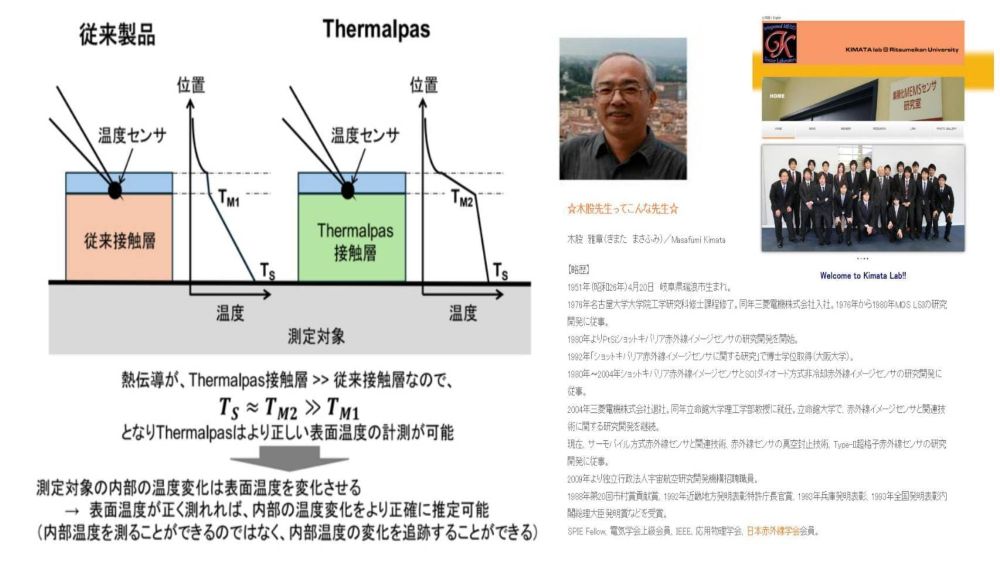
From a technical perspective, the diagram clearly illustrates the difference between the Thermalpas thermometer and a conventional thermometer.
Thanks to its highly thermally conductive contact layer, Thermalpas produces a measurement value that is much closer to the actual surface temperature:
Tₛ ≈ Tₘ₂
In contrast, a conventional thermometer may produce a larger measurement deviation:
Tₘ₁ differs significantly from Tₛ
This means that Thermalpas can track internal temperature changes more accurately by measuring the surface temperature with greater precision, thereby improving overall measurement reliability.
Additional Information
Thermalpas has received several international invention awards, including gold medals in Malaysia, Geneva, and South Korea. Patents have also been registered in Taiwan and mainland China.
The product has obtained multiple certifications, including:
-
IP68 waterproof and dustproof certification
-
DAF 5.5 kV withstand-voltage insulation certification
-
Flame-retardant and material certifications for the product body
Thermalpas has been sold on the market for nearly 20 years and has a service life of approximately seven years.
It has been widely applied in many industries, including semiconductor factories such as TSMC. Typical applications include temperature monitoring for motor starting capacitors and wastewater monitoring systems using fiberglass pipes, where the product can provide early warning of abnormal temperature conditions.
Thermalpas continues to be sold worldwide, with new applications and market opportunities being developed continuously.

 service@yongjia.com.tw
 +886-2-2731-8995